%20copy.png)

Flashing, Skylights, and Roof Penetrations: The Small Details That Cause Big Leaks
Ask most homeowners where a roof leak comes from, and they'll picture a bad patch of shingles somewhere in the middle of the roof — a missing tab, a worn spot, maybe storm damage from the last hurricane. That's a reasonable guess. Rarely does anyone guess roof flashing — and in a lot of cases, that's exactly where the real problem is.
A large share of real-world roof leaks don't start on the open field of the roof at all. They start at the small, easy-to-overlook places where the roof surface gets interrupted — around a chimney, a skylight, a vent pipe, a satellite mount, or wherever two roof planes meet in a valley. These spots depend on a thin layer of metal and sealant called flashing to keep water out, and when flashing fails, the leak that shows up inside your home can look nothing like where the water actually got in. In Tallahassee, where heavy rain regularly arrives sideways on a gust of wind, those small details matter even more than in drier, calmer climates. This article covers what flashing actually is, where it's most likely to fail, how to tell a penetration leak apart from a general roof-surface leak, and why a problem this small is so easy for an untrained eye to miss.
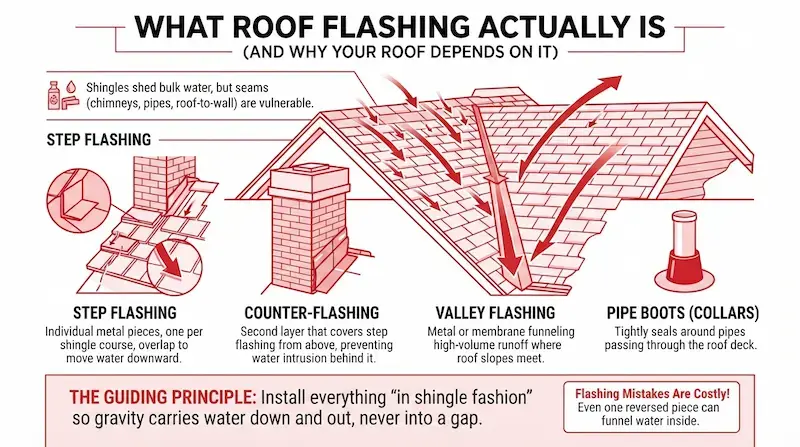
What Flashing Actually Is (And Why Your Roof Depends On It)
Shingles do the bulk of the work shedding water off a roof, but they can't do it alone anywhere the surface isn't flat and continuous. Every chimney, pipe, skylight, and roof-to-wall intersection creates a seam — and seams are where water gets in, especially when wind is pushing rain sideways instead of letting it fall straight down.
Flashing is the thin, weatherproof material — almost always metal, sometimes rubber for pipe boots — installed at those seams to redirect water back onto the roof and away from the gap. A few terms worth knowing, since this is a more technical topic than most:
Step flashing — individual L-shaped metal pieces, one per shingle course, woven into the roofing material alongside a chimney or wall, each overlapping the one below so water passes downward in stages, like shingles themselves.
Counter-flashing — a second layer, usually built into a chimney's mortar joints or a wall, that folds down over the top of step flashing. Step flashing handles water at the roof line; counter-flashing keeps water from getting behind it from above.
Valley flashing — metal or membrane laid where two roof slopes meet and funnel water together, concentrating far more runoff than any single section of open roof handles on its own.
Boots or pipe collars — rubber or metal sleeves fitted tightly around a vent pipe where it passes through the roof deck.
The guiding principle behind all of it, per Building Science Corporation's technical guidance on flashing details, is that every layer must be installed "in shingle fashion" — overlapping so gravity carries water down and out, never into a gap where wind can drive it backward (Building Science Corporation, "Common Flashing Details"). That's also why flashing is so unforgiving of small mistakes: one piece installed backward, and the whole system can funnel water exactly where it isn't supposed to go.

Chimneys: The Classic Flashing Failure Point
Chimneys are one of the most common places flashing fails — a masonry chimney and a shingle roof are two completely different materials meeting at a sharp angle, moving independently as they expand and contract with heat.
A properly flashed chimney has both layers described above: step flashing woven into the shingles, and counter-flashing embedded into the mortar and folded down over it. This Old House's guide to leakproof flashing specifically warns against a shortcut some installers take — using one continuous piece of metal instead of individual step-flashing sections — because a solid piece lets water get behind it and under the roof deck instead of being carried down in controlled stages (This Old House, "Leakproof Flashing").
Common Chimney Flashing Failures
Mortar joints holding the counter-flashing crack or crumble over time, loosening its grip.
Sealant used in place of proper counter-flashing dries out, shrinks, and cracks — it was never meant to be a permanent water barrier on its own.
A single rusted-through step-flashing piece, hidden under the shingle above it, impossible to spot without lifting the roofing material.
A chimney below the roof ridge needs a small diversion structure called a cricket to split water around it instead of pooling against its uphill side; where one is missing or undersized, water backs up during heavy rain.
Skylights: Where the Roof and the Window Meet
Skylights bring a genuinely different failure mode into the picture, because they're not just a roof penetration — they're a window installed horizontally, sitting directly in the path of every drop of rain that falls on that section of roof.
Skylights depend on a flashing kit engineered specifically for the unit — head flashing above, step flashing along the sides, and an apron or sill flashing below — integrated with the roof's water-shedding layers rather than just caulked around the edges. Building America's Solution Center (a U.S. Department of Energy resource) notes that skylight flashing has to tie the mechanical curb into the roof's drainage layers with proper overlap, the same shingle-style layering principle that governs every other penetration on the roof (Building America Solution Center, "Flashing of Penetrations in Existing Roofs").
Two things make skylights a little riskier than most penetrations: they're a larger opening in the roof deck than a vent pipe or antenna mount, so a flashing failure has more surface area to leak through; and age matters more here — the flashing kit and the seals around the glazing itself have a service life, so a skylight installed years ago, even if done correctly, can be due for a look simply because the materials around it have aged.
Vent Pipes and Roof Boots: Small, But High-Failure
Plumbing and exhaust vent pipes are probably the single most common penetration on a residential roof — most homes have several — and the rubber boot sealing each one is one of the shorter-lived components up there. Unlike metal flashing, rubber pipe boots break down under UV exposure and Florida's intense summer sun, cracking or splitting where the rubber wraps around the pipe. Building America's Solution Center outlines a multi-step process for properly flashing a plumbing vent — sealant, self-adhered membrane, and a metal flashing base overlapping the surrounding shingles — a reminder that even a small, unglamorous penetration depends on several correctly layered materials, not just a rubber ring dropped over the pipe (Building America Solution Center, "Flashing of Penetrations in Existing Roofs").
This category also covers penetrations homeowners don't always think of as "roof penetrations" at all: satellite dish and antenna mounts, often installed after the original roof and sometimes secured with just lag bolts and caulk instead of proper flashing; and solar attic fan mounts — a service KFR installs directly, and one more reason a professional installation matters, since a fan cut into the roof deck needs the same shingle-style flashing as any other penetration, done right the first time rather than re-opened later to fix a leaky retrofit.
Valleys: Where Water Volume Concentrates
A valley is where two roof slopes meet at an angle and funnel their combined runoff into one channel — so a valley isn't just another seam, it's handling significantly more water than any equivalent stretch of open roof around it. Valley flashing (or a woven-shingle valley design, depending on the roofing material) has to carry that concentrated volume without letting it back up under the surrounding shingles, particularly during the heavy, wind-driven rain North Florida's storm season regularly brings. Debris — pine needles, leaves, shed granules — collects in valleys more than anywhere else on the roof, and a clogged valley forces water to pool and search for the nearest gap instead of draining straight through.
Why These Leaks Are Easy to Miss
Here's what makes penetration leaks genuinely different from a general roof-surface leak, and why they're so easy to miss or misdiagnose:
Water travels before it shows up. A leak can enter the roof deck in one spot and travel several feet along a rafter before dripping onto a ceiling, so the stain inside is often nowhere near the actual failure.
The failure point is often hidden. Step flashing is woven under shingles by design — so a rusted or shifted piece is invisible without lifting the roofing material.
Damage builds slowly and conditionally. A cracked pipe boot may only leak during wind-driven rain from a specific direction — common in Tallahassee's storm season — making the leak feel "random."
A ground-level inspection won't catch it. Most failure points require getting on the roof to see the flashing itself, not just its outer edge.
This is also why penetration leaks are often small in scope — a repair might mean replacing a section of step flashing or a pipe boot, not a full roof — but large in consequence if ignored, since sustained moisture intrusion can lead to wood rot, insulation damage, and mold well before it ever shows up as a visible drip.
The KFR Difference
KFR Roofing Solutions is a proud Black-owned, family-owned business built right here in the Tallahassee community, and topics like this one are exactly why we lean so hard into education first. Flashing and penetration issues are the kind of thing a rushed inspection can walk right past — not because they're hard to fix, but because they're easy to overlook if a contractor isn't specifically trained to look for them. We'd rather show a homeowner exactly what we found and explain it plainly than push a sale on vague reassurance.
That's why our inspections look closely at chimneys, skylights, vent boots, and valleys, not just the open field of shingles. If we install a solar attic fan, gutter system, or any other add-on that requires cutting into your roof deck, that penetration gets flashed to the same standard as everything else we touch. And because a repair can be an unplanned expense, we offer zero-down financing and a price match program so cost isn't the reason a small, fixable leak turns into a bigger one.

Practical Tips: Warning Signs You Can Spot Yourself
You don't need to get on the roof to catch some early warning signs. A few things worth checking periodically, especially after heavy or wind-driven rain:
Ceiling stains near a chimney, skylight, or a wall running alongside a roof line — a strong tell the source is a penetration, not the open roof.
A musty smell in the attic or top-floor closets, which can show up before a visible stain does.
Daylight visible around a chimney or skylight curb when looking up from inside the attic.
Discoloration, rust streaks, or visibly lifted metal around any penetration, visible with binoculars from the ground.
Granule buildup or debris piled up in a roof valley, which traps moisture against the flashing underneath.
A leak that only happens during storms with wind from a particular direction — a classic sign of wind-driven rain finding a small gap calm rain never reaches.
Any recent add-on — satellite dish, antenna, solar equipment — not installed by a licensed roofing contractor, a common place for flashing to be skipped.
Annual professional inspections, ideally including a look from the attic, where sheathing stains show up long before a ceiling does.
If you spot any of these, the fix is usually far simpler while it's still small — a section of flashing or a pipe boot, not a full roof.
Frequently Asked Questions
What exactly is roof flashing?
Flashing is the metal (or, for pipes, rubber) material installed anywhere a roof surface is interrupted — chimneys, skylights, vent pipes, valleys, roof-to-wall intersections — to redirect water around the gap instead of letting it seep underneath.
Why do flashing and penetration leaks happen more often than leaks on the open roof?
The open roof field is a continuous, engineered surface designed to shed water. Every penetration interrupts that surface and depends on flashing, layered correctly, to keep water out — which is simply more seams and more chances for a small installation or aging issue to let water through.
How can I tell if my leak is coming from flashing versus the shingles themselves?
It's hard to be certain without an inspection, but location is a strong clue: a stain that lines up with a chimney, skylight, vent, or valley is much more likely to trace back to flashing than to a stain in the middle of an open roof section.
Are flashing repairs expensive?
They're typically much smaller in scope than a full roof replacement, since the work is often isolated to one location. Cost depends on what's found once the area is opened up, so a professional inspection and estimate is the best way to know for sure.
Do skylights leak more than other roof penetrations?
Skylights involve a larger opening and more components — glazing seals plus a multi-part flashing kit — so there's more that can age or fail over time than a smaller penetration like a vent pipe. That doesn't mean every skylight will leak, just that it's worth including in a regular inspection.
Can I inspect my own roof's flashing from the ground?
You can spot some warning signs from the ground or attic — rust streaks, visible gaps, stains, a musty smell — but a full inspection usually requires getting on the roof and, sometimes, carefully lifting shingles to see step flashing woven underneath. That's best left to a trained professional.
Does adding a satellite dish or solar equipment to my roof create a new leak risk?
It can, if the installer doesn't properly flash the new penetration. Anything that requires cutting into the roof deck should be flashed to the same standard as the rest of the roof — worth asking about directly before any add-on installation.
How often should flashing be inspected?
Most roofing professionals recommend flashing get a look during any regular roof inspection, at least annually, with an extra check after major storms — since wind-driven rain is exactly the kind of weather that exposes a small gap calmer weather never reveals.
Ready for a Closer Look at Your Roof's Weak Points?
If you've noticed a ceiling stain near a chimney or skylight, or it's simply been a while since anyone looked closely at the roof flashing around your home's penetrations, KFR Roofing Solutions offers free consultations for Tallahassee and North Florida homeowners — a clear, honest read on exactly what we find, no pressure, no upsell. Call us at 850-576-1032 to schedule your free consultation or request a free quote today.
Disclaimer: This article is provided for general informational purposes only and does not constitute professional roofing, engineering, or construction advice. Roof conditions, materials, and penetration details vary by home. Always consult a qualified, licensed roofing professional for an inspection and assessment of your specific property.